
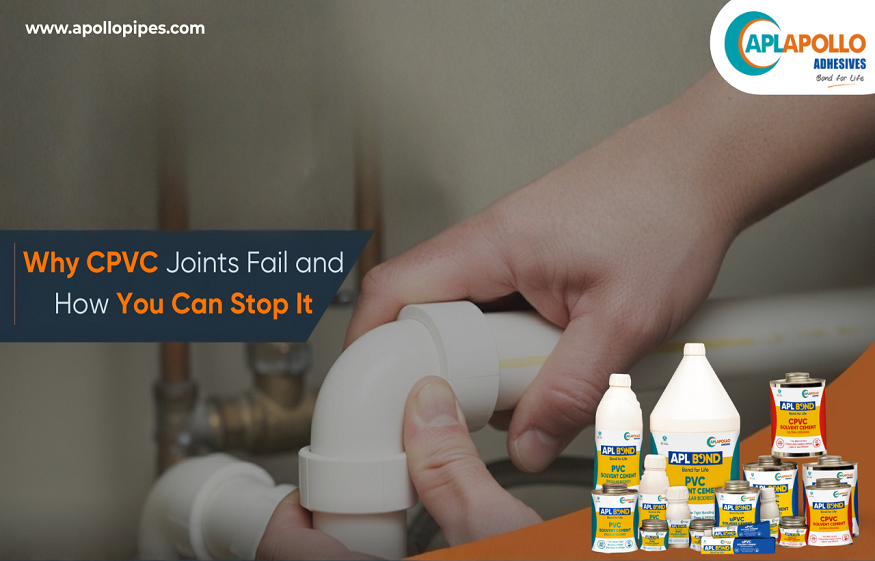
CPVC piping system is popular in residential, commercial and industrial plumbing because it is strong, corrosion-resistant and can easily accommodate hot and cold water applications. Yet even good-quality CPVC pipe can have leaking problems if the joints are not properly connected. Fortunately, joint failure can usually be avoided by preventing inadequate or over application of solvent cement, poor workmanship and inferior materials. Here are the details, why CPVC joint failure occurs and how to prevent costly repairs on your plumbing system.
Importance of Proper Jointing in CPVC System
In CPVC piping system the joints are more important than the pipe itself as that is where the pipe and fitting get joined to form a water distribution system. A weak joint will cause leakage, pressure loss and damage to pipes in long term use. That is why it is important to use the right solvent cement and apply it properly.
The right quality of solvent cement will chemically soften the pipe and fitting, forming a strong and leak-proof connection to the outside world through a molecular bond when cured.
Common Causes of CPVC Joint Failure
-
Low-Quality Solvent Cement
A significant cause of CPVC joint failure is poor quality or incompatible solvent cement. Low-quality solvent cement may fail to bond the pipe to the fitting resulting in a weak joint and leakage. The best quality solvent cement formulated for CPVC pipes should always be selected to ensure the best possible bond strength and long lasting performance.
Read More: How often should you buy new furniture for your living room?
A dirty, wet or rough surface may interfere with the solvent cement’s ability to properly bond the pipe and fitting. Rough, dirty, wet or greasy pipe ends may cause the joint to fail and leak. So, it is to be ensured that the pipe and fitting should be clean before the solvent cement is used.
-
Improper Use of Solvent Cement
Applying too little or too much solvent cement can also cause a weak joint. A small amount will not provide an adequate seal while excess cement may cause the pipe to weaken or interfere with water flow. Solvent cement should be applied evenly to both the pipe and the pipe fitting.
-
Inadequate Curing Time
Many joint failures occur when water pressure is applied to a joint before the solvent cement has had time to fully cure. Full curing allows the joint to achieve the maximum possible bond strength.
The temperature and humidity of the piping system and the size of the pipe will determine how long the joint must cure. Curing times based on the manufacturer’s specifications should always be followed before the system is used.
-
Bad Installations
Improperly centered, over forced, or inserted too deep can break the joint. CPVC pipes must be installed gently, without unnecessary bending. Professional installations guarantee a solvent cement bond that will be leak-free for years to come.
How to Prevent CPVC Joint Failure
-
Use High Quality Solvent Cement
Always use high quality solvent cement for creating reliable CPVC joints. Quality cement provides faster setting and stronger bonding to pressure and temperature variations. It also enhances the performance of the piping system.
-
Track Proper Installation Steps
For strong joints, proper installation is necessary. There is a need to cut pipes evenly, dry the surfaces, apply the correct amount of solvent cement and allow proper curing time. These steps lessen the chances of joint failure.
-
Compatiblity
Using mismatched fittings can affect the bonding process. It is to be ensured that pipes, fittings and solvent cement are designed for the same CPVC application. Compatible materials help create sturdy joints.
-
Excessive Pressure and Stress
Excessive pressure or bending can weaken the bonded area. A well-designed piping layout helps maintain joint stability and efficiency of system.
Read More: The Best Automatic Vacuum Cleaner for Dry and Wet Surfaces
APL Apollo’s Solvent Cement
APL Apollos is the leading manufacturer of high-quality solvent cement. A strong pipe alone can never guarantee a good plumbing system unless the joint is strong and secure. Even the best pipe will become useless if not properly connected. This solvent cement is specially formulated for joining pipes and fittings which can form a strong, durable and leak-proof joint that can improve the efficiency of the piping system. APL Bond solvent cement is manufactured with stringent quality controls, available in three types, CPVC solvent cement, uPVC solvent cement and PVC solvent cement, for different types of piping applications. Well-known for being a fast-setting and strong bonded solvent cement, it offers a quick and hassle-free installation. The superior quality formulation ensures a strong bond, long-lasting performance, and reliable sealing and APL Bond solvent cement is the best choice and very popular in residential, commercial, and industrial plumbing systems.